
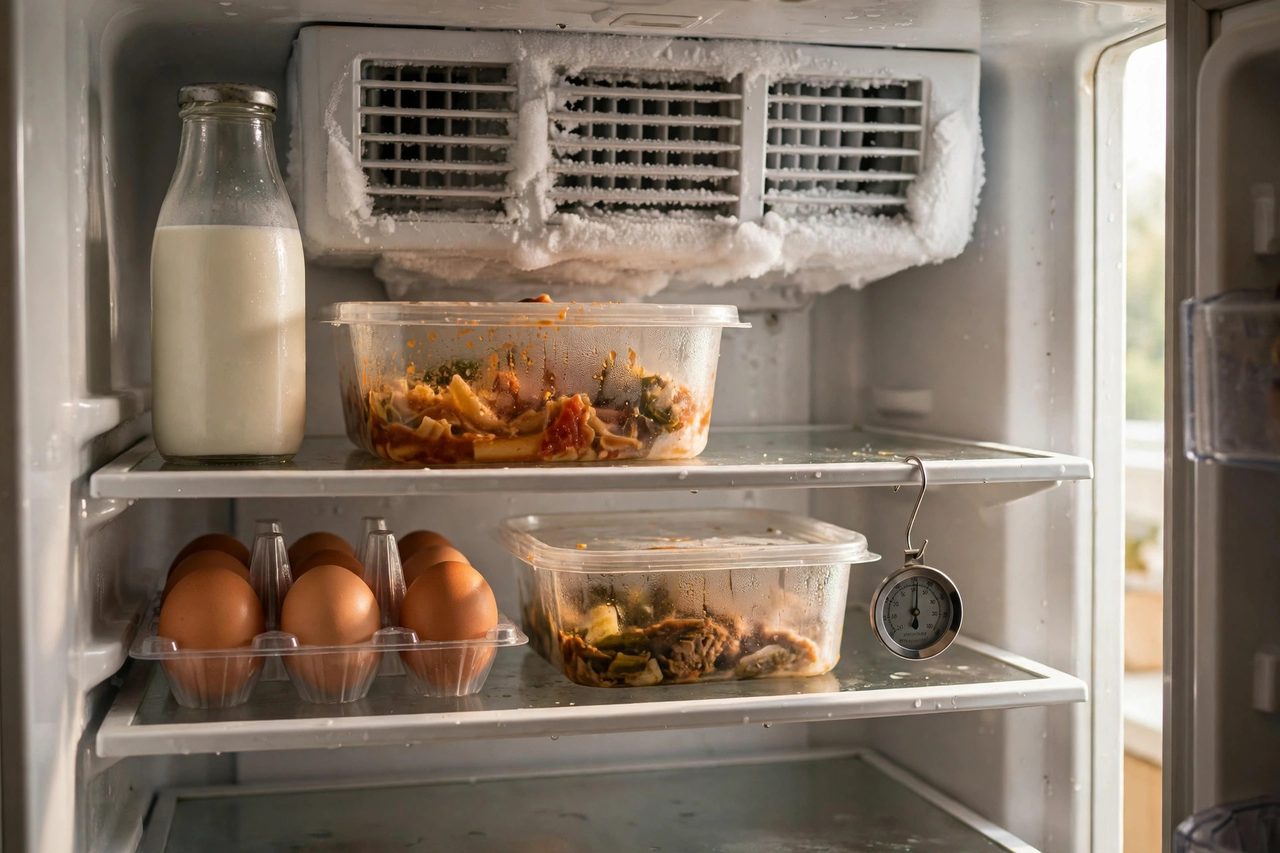
Wait — how can one half be cold and the other half warm?
Here's the part nobody tells you: a refrigerator only has one cooling system, and it lives in the freezer. The evaporator coil behind the freezer's back wall is the only place your fridge actually gets cold. A fan then pushes that cold air through a vent into the fresh-food section, and a damper controls how much gets through.
So the fridge side has no cold of its own — it borrows the freezer's. That's why this failure pattern is so lopsided. If the coil frosts over, the fan fails, or the vent between the two sections blocks, the freezer — sitting right next to the coil — stays cold the longest, while the fresh-food side quietly warms. Your fridge isn't half-broken. It's starved of air that exists one wall away.
This design is also why the fault is so often survivable. The expensive part of the system — the compressor and the sealed refrigerant circuit — is usually still healthy. What's failed is the delivery system: ice, a fan, a sensor. Delivery problems are parts problems, and parts problems are the affordable kind.
What's the most common cause? Frost strangling the airflow
Nine times out of ten, the villain is frost strangling the evaporator coil. Your fridge is supposed to defrost itself several times a day: a heater melts the frost off the coil, the water drains away, and cooling resumes cleanly. When any link in that system fails — the heater, the defrost sensor, the control that times it — frost builds instead of melting. Week by week the coil disappears inside a block of ice.
Now the evaporator fan is trying to blow air through a wall of frost, and it can't. Some owners hear the evidence before they see it: a buzzing, clicking or ticking from the freezer, which is the fan blade clipping ice on every revolution. Open the freezer and run your hand along the back wall. Thick frost on that wall, plus a warm fridge, is the signature of defrost failure — the single most common root cause of this whole scenario.
Fridge getting warmer while you read?
Describe the brand and the symptom — we will match you with a local pro who services your brand, with a written price range before any work starts.
Call (972) 555-0148What can I check before I call anyone?
Before you call anyone, do the five-minute checks. First, look at the vents: on most French-door and side-by-side models they're on the back or side wall of the fridge section, and a wall of frozen pizza boxes stacked against them will warm a fridge all by itself. Rearrange anything that's sealing them off.
Second, listen at the freezer. You should hear the fan running when the compressor runs; silence plus warmth can mean the fan motor has died. Third, check that frost on the back wall — patchy frost is normal, a solid white fur coat is not. Fourth, test the door gaskets with a dollar bill: close the door on it and pull; it should drag. Finally, if your fridge hasn't had its condenser coils cleaned in a year or two, dust and pet hair down there make everything run hotter and weaker.
One more check costs nothing: the temperature setting itself. After a big shop, someone often nudges the fridge control colder 'to help' — then the freezer control gets changed too, and on many models the freezer setting is the one that actually governs airflow to the fridge. Set both back to the manufacturer's recommended marks and give it a day before concluding anything.
When is it the fan, the defrost system — or the compressor?
Fan, defrost system or compressor — the symptoms separate them fairly cleanly. A failed evaporator fan gives you the lopsided pattern with little or no frost: freezer cold, fridge warm, and an eerily quiet freezer. A failed defrost system gives you the same warmth plus the frost-covered back wall and the fan-clipping noises. Both are mid-range repairs — in Angi's 2026 national data, fan motors and defrost parts typically run $100–$250 fitted.
The compressor is the diagnosis owners fear, but it's honestly the least likely of the three here, because a dying compressor usually warms both sections together. If the freezer is genuinely holding 0°F, the sealed system is still doing its job. Where owners get burned is accepting a compressor quote for a fan problem — the fix differs by several hundred dollars, and a good pro shows you the frost, the fan or the test readings before quoting either.
How fast do I need to act?
Faster than feels reasonable. The fresh-food section crosses 40°F long before it feels warm to your hand, and from that point the USDA's four-hour guidance applies to milk, meat, eggs and leftovers. In a Colony summer — and 2026 gave the city 52 days at or above 100°F — a compromised fridge loses its cold quickly once the door starts opening for dinner.
So the practical sequence is: thermometer in, perishables moved to the freezer side or a cooler with ice, vents checked, back wall inspected — and the call made the same day, not after the weekend. The good news buried in this frustrating fault is that it's very often a $100–$250 part rather than a dying appliance. Our not-cooling guide walks the full diagnostic tree if you want the deep version, or call and we'll match you with a local pro who'll find it in person.
Frequently asked questions
Is it normal for this to happen suddenly in summer?
Yes, and the timing is not a coincidence. A fridge works hardest in summer, and The Colony's heat — 52 days at or above 100°F in 2026 — exposes defrost faults and tired fans that coped fine in spring. Nearly every 'fridge warm, freezer cold' case a pro sees arrives between June and September, because marginal parts fail exactly when the system stops getting any rest.
Can I just move everything into the freezer side?
Briefly, yes. The freezer section will usually hold safe temperatures for a day or two, so move milk, meat, eggs and leftovers there while you arrange the repair. Don't overload it, though — shelves packed solid block the airflow the freezer itself needs to stay cold, and you'll end up with two warm sections instead of one. Leave gaps, and keep the most perishable food at the back near the cold air outlet.
How much does this repair usually cost?
In Angi's 2026 national ranges, the common causes of this fault run $100–$250 — evaporator fan motors, defrost heaters and thermostats all sit in that band. Control boards run $200–$500, and true compressor failures $300–$800. The spread is why a real diagnosis matters before you agree to a price.
Will unplugging the fridge overnight fix it?
Unplugging overnight melts the frost that's choking the coil, and the fridge often works again for a week or two afterwards. Owners mistake that for a fix. The defrost fault that created the ice is still there, so the frost — and the warm fridge — return. Use the reset as breathing room, not a repair.
Fridge trouble in The Colony? The food clock is running.
Living this story right now? Call ChillCrew at (972) 555-0148 and tell us 'freezer's fine, fridge is warm' — we'll connect you with a licensed local pro who knows exactly where to look.
Call (972) 555-0148