
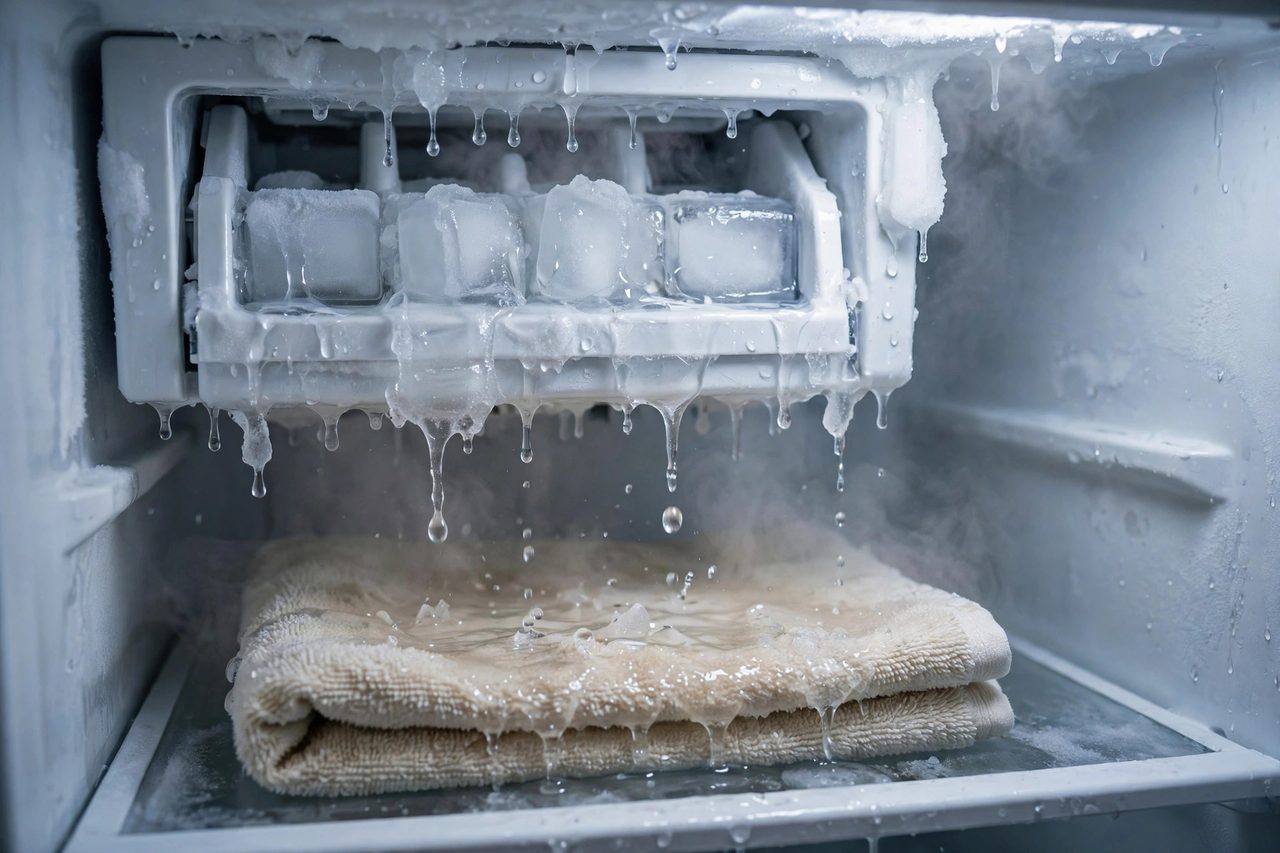
What does forced defrost actually do?
Forced defrost is a service mode built into Samsung refrigerators. It runs the defrost heaters on command instead of waiting for the fridge's normal cycle, melting frost off the evaporator and, on French-door models, around the ice room. Techs use it as a diagnostic: to clear a frozen unit so they can test fans and sensors, or to confirm that a heater circuit works at all.
Here is what it does not do. It doesn't repair a torn ice-room seal, replace a weakening heater, fix a sensor that's misreading, or stop humid air getting where it shouldn't. It melts the evidence. The frost you see is a symptom that took days to grow, and the conditions that grew it are still in place when the cycle ends — which is why the ice comes back on an almost predictable schedule.
Think of it the way a tech does: a fridge that needs forced defrost once had an event — a door left ajar, a storm outage. A fridge that needs it every week has a condition. The button treats events. It cannot touch conditions.
Why does the frost keep coming back?
On Samsung's French-door designs, the ice maker lives in its own insulated room inside the refrigerator compartment. That room must stay sealed: below freezing inside, refrigerator temperatures outside, and a gasket line between them. The Colony's climate works that seal hard. Summer dew points here sit around 70°F, so every door opening floods the cabinet with warm, wet air — and any gap in the ice-room seal lets that air creep into a sub-zero space.
Moisture that reaches sub-zero surfaces freezes onto them: the fill tube narrows, the fan frosts, the bucket cakes over, the auger jams. It is not a coincidence that these freeze-ups peak in summer and that they worsen gradually. A seal that leaked slightly in April leaks worse by August. Layer on a defrost sensor or heater that no longer clears the coil fully, and each cycle leaves a little more ice than the last — which is why your defrosts keep getting closer together.
Fridge getting warmer while you read?
Describe the brand and the symptom — we will match you with a local pro who services your brand, with a written price range before any work starts.
Call (972) 555-0148Can forced defrosting damage anything?
An occasional forced defrost won't hurt your fridge — it's a manufacturer function, after all. The risks grow with frequency and enthusiasm. Repeated forced cycles put thermal stress on plastic liners, ice buckets and water lines that were designed for the fridge's own gentler schedule. Meltwater has to go somewhere: a heavy thaw can overwhelm the drain, and water that refreezes behind panels can wedge fans and crack fittings over time.
The bigger cost is diagnostic. Every reset clears the slate — frost gone, temperatures normal for a few days — so by the time a tech sees the fridge, the evidence of which part failed has been melted away. If you know a call is coming, take photos of the frost pattern first. Where the ice builds is genuinely useful information: it points at the seal, the fan or the fill tube before a single screw comes out.
There's also the water bill nobody sees. Each heavy thaw sends meltwater through a drain designed for the fridge's own modest defrost cycles. When that drain ices at its outlet — as it tends to in a unit already struggling with frost — the next thaw spills inside the cabinet instead, and owners find the leak on the kitchen floor days later, blaming the wrong component entirely.
What repair actually ends the freeze-up cycle?
The repair that ends the cycle addresses the cause your defrosts keep revealing. On most Samsung French-door units that means resealing the ice room — restoring the insulated boundary so humid air stops reaching sub-zero parts — alongside replacing whichever component has actually failed: a frosted fan motor, a tired defrost heater or sensor, or an ice maker module whose own housing has warped or cracked from repeated freezing.
In Angi's 2026 national data, ice maker repairs typically run $100–$300, and the re-seal work that makes them last sits in that same general range rather than in compressor territory. The honest test of a quote is whether it names the cause. 'We'll defrost it and replace the ice maker' without touching the seal is how owners end up with a new module frosting over by the following month — a complaint that runs through years of Samsung owner reviews like a chorus.
Repair the ice maker, reseal the room — or replace the fridge?
Replace the ice maker module when the module itself is the failure — cracked housing, dead motor, a heater fault inside the unit — and the ice room's seal checks out. Fix the seal first when the frost pattern points there, whatever shape the module is in. And step back for the bigger question when the fridge is older: on a unit past ten years with a repeat ice-room history, compare the repair against the 50% rule — half the cost of a comparable new fridge — before spending.
What not to do is let the ritual become the plan. A fridge you defrost weekly is a fridge whose food compartment warms a little more each cycle, whose fan is chewing ice, and whose eventual failure will pick the least convenient weekend of the summer. The freeze-up guide linked below maps the symptoms in full — or make the call and let a local pro read the frost in person.
And if you do book the repair, do one last owner a favour — yourself, in a month: take a photo of the ice room before the next forced defrost, date it, and keep it with the invoice. If the freeze-up returns inside the repair's warranty window, that photo is the whole conversation.
Frequently asked questions
How often can I safely run a forced defrost?
Occasionally, as a diagnostic or a one-off rescue, it's fine — that's what the function exists for. The honest limit is frequency: if you need it weekly or even monthly to keep ice coming, the fridge is telling you the ice room has an unresolved fault. At that point forced defrost is symptom management, not maintenance.
Will unplugging the fridge overnight do the same thing?
Mostly, yes — 8 to 12 hours unplugged with the doors open melts the same frost, just slower. It has the same limitation, too: it clears the ice without fixing the seal, the fan or the sensor that let the frost build. Expect the freeze-up to return on the same schedule.
Why are my ice cubes small or hollow, too?
Often it's the same story at an earlier stage. Undersized or hollow cubes usually mean the fill tube is partially iced or water pressure to the ice maker is dropping — frost building in the same places that eventually freeze the unit solid. Treat changing cube quality as the ice room's first warning, not a separate quirk.
Can I claim anything from the Samsung ice maker lawsuit?
Honestly: no. The Samsung ice-maker class action (Bianchi v. Samsung) was dismissed in January 2024 after individual settlements, and as of 2026 there is no open settlement, claim form or recall for owners to join. Your practical routes are a proper repair — or checking whether your model has any remaining factory parts coverage before you pay.
Fridge trouble in The Colony? The food clock is running.
Tired of the weekly defrost ritual? Call ChillCrew at (972) 555-0148 and we'll connect you with a licensed local pro who repairs Samsung ice rooms properly — seal, module and all.
Call (972) 555-0148