
What temperature is a standard refrigerator actually rated for?
Every refrigerator carries an ambient operating range — the air temperature around the unit within which it can hold 37–40°F inside the fridge and 0°F in the freezer. For most standard models that range tops out around 100°F. The Colony's climate walks straight past that ceiling: National Weather Service normals for the DFW area show average highs of 95.6°F in July and 95.8°F in August before you account for a closed garage, which traps the day's heat and adds the compressor's own exhaust warmth on top.
In 2026 the Dallas–Fort Worth area logged 52 days at or above 100°F. Inside a closed Colony garage with a metal door facing the afternoon sun, temperatures past 110°F are routine. The fridge sitting in it is not malfunctioning when it struggles — it is being asked to work outside the conditions it was rated for, for weeks at a time.
What happens to the compressor when the garage passes 110°F?
A refrigerator cools by moving heat from inside the cabinet to the air around it. The hotter that surrounding air, the harder the compressor must work to push heat into it — and the less time it spends resting. In a 110°F garage the compressor can run almost continuously, which means continuous wear on the compressor itself, on the start relay that fires it dozens of times a day, and on the condenser fan that has to shed all that heat.
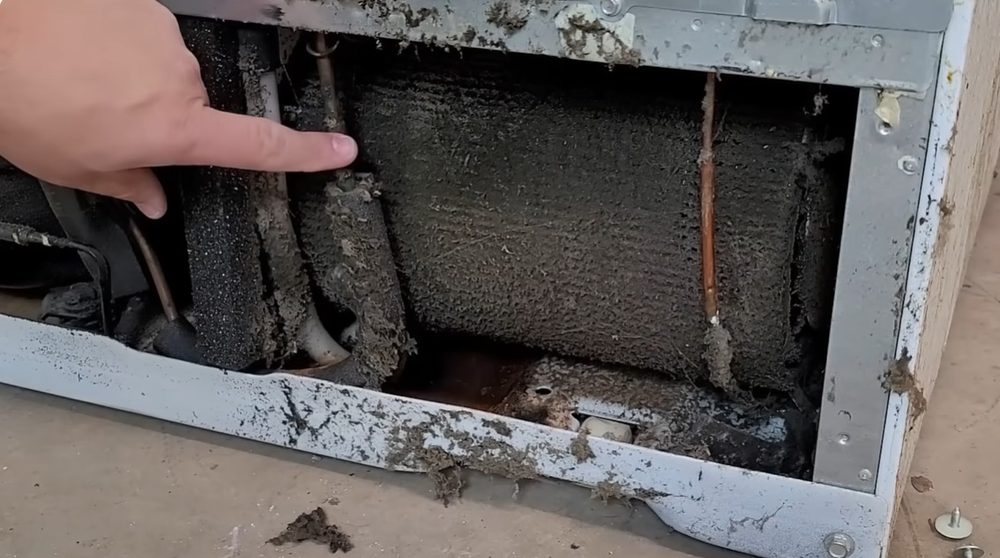
The failure sequence is predictable: the unit runs longer and drinks more electricity, then a marginal part — fan motor, relay, or an age-weakened compressor — gives up under the load, most often in August. The owner experiences it as sudden death: drinks warm, freezer soft. In truth it was a whole summer of overwork arriving at its bill. Dirty condenser coils accelerate everything — a dust-blanketed coil cannot release heat even at moderate temperatures.
Fridge getting warmer while you read?
Describe the brand and the symptom — we will match you with a local pro who services your brand, with a written price range before any work starts.
Call (972) 555-0148Why do garage fridges die in August and not in May?
August combines every stress at once: the highest normal highs of the year, overnight lows around 75–76°F that give the garage no chance to cool down, and peak usage — school holidays, cookouts, extra drinks and ice for every gathering. The fridge is opened more, loaded with warm items more, and rested least, all while its cooling machinery is at its annual maximum load.
That is why "it worked fine in June" is no defence: June's normal high is 91.5°F, and August adds sustained triple-digit stretches. A borderline compressor, fan or relay is not unlucky in August — it has reached the part of the year it could no longer survive. A pre-summer service visit in May or June is timed exactly to interrupt that story.
Does a Texas garage cause problems in winter too?
Texas garages argue at both ends of the thermometer. The same area that bakes in August averages 29.2 days a year at or below freezing, and a standard fridge has a winter failure mode owners find baffling: in a cold snap, the freezer stops freezing while the fridge section seems fine. The thermostat that controls the compressor sits in the fresh-food section. When the garage itself drops towards fridge temperature, the compressor has little reason to run — so the freezer, which depends on regular compressor cycles, drifts above 0°F and food softens.
The table below maps the garage's year. If your unit's behaviour matches the row, you are looking at an ambient problem before you are looking at a broken part.
| Garage temperature | What the fridge does | What to do |
|---|---|---|
| Above 110°F | Compressor runs near-continuously; cooling falls behind; parts wear fast | Ventilate, shade, clean coils; consider garage-ready replacement |
| 100–110°F | Holds temperature but at high effort and cost | Improve airflow and clearance; monitor with a thermometer |
| 50–100°F | Normal operating range — the fridge's comfort zone | Routine care only |
| 38–50°F | Freezer may drift warm as compressor cycles shorten | Check freezer contents; a garage kit or garage-ready model fixes it |
| Below 38°F | Freezer thaw risk on standard models; controls may misread | Move critical frozen food indoors during cold snaps |
What fixes actually help a garage fridge survive?
Start with air. A fridge needs clearance around its sides and back to dump heat — pulling it a few inches off the wall and clearing stored boxes away from the coils costs nothing and helps immediately. A louvre, vent or even a small fan that moves garage air on the hottest afternoons lowers the ambient the unit fights. Keep the door seals clean and the condenser coils vacuumed at least twice a year in a garage environment; dust loads are heavier than in a kitchen.
Then decide whether the unit itself fits the job. Garage-ready refrigerators are built for this: rated for a much wider ambient span, roughly 38°F to 110°F or beyond, with insulation and components specified for the extremes and, on many, a small heater that keeps the freezer section working through winter cold. If your garage fridge is a decade-old hand-me-down from the kitchen, the honest comparison is between nursing it and replacing it with a model designed for where it actually lives.
What does a struggling garage fridge cost you every year?
ENERGY STAR estimates that keeping an old second refrigerator running can waste around $125 a year in electricity — and that figure assumes ordinary conditions, not a unit fighting a 110°F garage, where run-times stretch further. Combine the energy waste with the contents at risk (a garage freezer often holds the overflow meat and bulk buys), and the "free spare fridge" is quietly one of the more expensive appliances in the house when it is unhealthy.
The economics cut both ways. A fridge needing a fan motor, a start relay or a thorough coil service is usually worth saving — nationally most refrigerator repairs run $150–$400. A failed compressor on an old, inefficient garage unit is the crossover where replacement, ideally with a garage-ready model, becomes the rational spend. If yours is groaning through this summer, call ChillCrew on (972) 555-0148 for a local pro who will tell you honestly which side of that line your unit is on.
Frequently asked questions
Is it actually bad to keep a refrigerator in the garage?
Not bad — but it works the unit harder. A standard fridge can run in a garage for years with airflow, shade and clean coils, yet it will use more energy and age faster than the same unit indoors, especially through August. If the garage regularly bakes, a garage-ready model is the better long-term answer; if your unit is mid-life, the ventilation and maintenance steps on this page are the cost-effective middle path.
What maintenance matters most for a garage fridge in Texas?
One non-negotiable visit a year: coil cleaning and a gasket check before the heat arrives, ideally in May. Garage dust, pet hair and lawn clippings coat condenser coils faster than kitchen dust does, and a matted coil in a 110°F garage is the most common preventable cause of the August failures we hear about.
How is a garage-ready refrigerator different from a normal one?
Garage-ready models are typically rated to work across a much wider ambient range — roughly 38°F to 110°F or beyond — while standard fridges are rated for about 50°F to 100°F. Garage-ready units add insulation, components specified for temperature extremes, and on many models a small heater element that keeps the freezer working correctly during winter cold snaps, when a standard fridge's freezer can stop cooling.
Why does my garage freezer stop freezing in winter?
That is the classic cold-snap behaviour of a standard fridge. The thermostat sits in the fresh-food section; when the garage drops near that temperature, the compressor barely runs, and the freezer — which depends on those cycles — drifts warm and food softens. It is not broken, but the food is at risk. Fixes range from a garage heater kit fitted by a pro to a garage-ready model with dual controls.
Should I repair a dying garage fridge or just unplug it?
Run the honest maths. ENERGY STAR puts the waste of an old second fridge at up to about $125 a year, and a garage unit in Texas heat sits at the thirsty end of that estimate. If the compressor or sealed system has failed on an older unit, repair costs run into the same territory as a basic replacement. A fan, relay or coil problem, by contrast, is usually worth fixing.
Fridge trouble in The Colony? The food clock is running.
Garage fridge struggling or already dead in the heat? Call (972) 555-0148 — a free referral to a licensed local pro in The Colony.
Call (972) 555-0148