
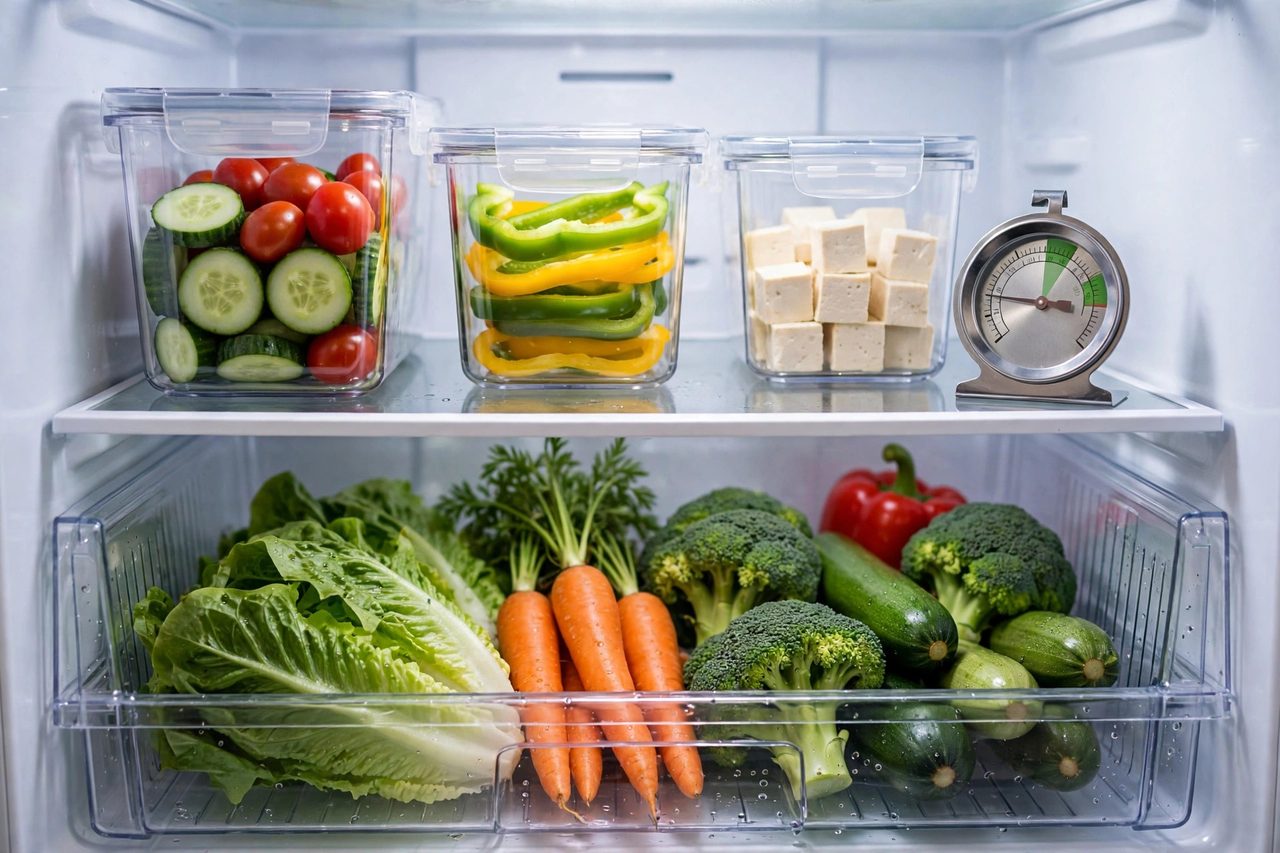
What temperature should a refrigerator and freezer be?
The USDA and FDA give the same two targets: the fresh-food section at 40°F or below, and the freezer at 0°F. Most pros set the fridge to 37–38°F, which holds the 40°F line even when doors open often or a hot dish goes in. The freezer's 0°F isn't about safety alone — it's where ice cream stays firm, frozen food keeps its texture, and anything stored long-term stays properly frozen rather than slowly thawing at the edges.
Two myths cause most of the trouble. First, the dial: settings marked 1 to 5 or 'colder' are not temperatures, and the same setting can read 36°F in January and 44°F in an August heatwave — The Colony recorded 52 days at or above 100°F in 2026. Second, the coldest setting is not the safest. Crank a fridge too cold and you freeze lettuce and eggs in the back while the door shelves — where the milk usually lives — still run warm.
How does the 4-hour rule work after a power outage?
When power fails, a closed refrigerator keeps food safe for about four hours. That number assumes the door stays shut — every opening swaps cold air for your kitchen's air, and in a summer outage the kitchen may be 85°F or hotter. After four hours above 40°F, the USDA's advice is blunt: discard perishables. Meat, poultry, milk, soft cheeses, eggs and leftovers go first on the toss list.
Your freezer buys you far more time. A full freezer holds safe temperatures for roughly 48 hours unopened; a half-full one, about 24 hours. Food that still has ice crystals, or that never rose above 40°F, can be cooked or refrozen. And one rule overrides all the others: never taste food to decide. Bacteria that cause food poisoning often leave no smell, no slime and no warning at all.
Practical help for Colony storm season: bagged ice or frozen water bottles moved into the fridge stretch the safe window, and a cooler with ice is a better home for the milk and meat than a warming cabinet. If an outage passes the four-hour mark, err on the side of the bin — and note the time the power failed, because 'about four hours' guesses have a way of becoming six.
Fridge getting warmer while you read?
Describe the brand and the symptom — we will match you with a local pro who services your brand, with a written price range before any work starts.
Call (972) 555-0148Keep or toss? The outage table
After any outage or cooling failure, work through the fridge shelf by shelf. This table follows standard USDA guidance for the foods Colony families ask about most.
| Food | After 4+ hours warm | Verdict |
|---|---|---|
| Milk and cream | Above 40°F for 4+ hours | Toss |
| Eggs in shell | Above 40°F for 4+ hours | Toss |
| Raw meat and poultry | Above 40°F for 4+ hours | Toss |
| Cooked leftovers | Above 40°F for 4+ hours | Toss |
| Mayonnaise and tartar sauce | Above 40°F for 4+ hours | Toss |
| Ketchup, mustard, pickles, jams | Above 40°F for 4+ hours | Keep — high acid or sugar protects them |
| Hard cheeses (cheddar, parmesan) | Above 40°F for 4+ hours | Keep — trim any surface mould generously |
| Butter | Above 40°F for 4+ hours | Keep for a day or two; flavour suffers first |
How do I check my fridge temperature properly?
The fridge's own display can be off by several degrees, so verify with a cheap appliance thermometer — one in each section, hung or stood where air circulates but not touching a wall or a cold air vent. Check first thing in the morning, after the longest closed-door stretch, for the most honest reading. If you adjust the controls, wait a full 24 hours before judging: a loaded fridge changes temperature slowly, and chasing the dial every few hours overshoots in both directions.
Do the check twice a year — once when the first real heat arrives, once before the holidays, when the fridge works hardest. A unit that crept from 38°F to 43°F over one summer is telling you something: dusty coils, a tired gasket, or a fan on its way out, all cheaper to fix early.
Why won't my fridge hold 40°F in a Texas summer?
Heat is the stress test. When a Colony kitchen hits the high 80s — or a garage fridge bakes in a space well past 100°F — the compressor runs nearly continuously, and any weakness shows up as a temperature the fridge can't pull down. Most standard refrigerators are rated for ambient temperatures of about 50–100°F; a Texas garage in August can exceed 110°F, which is why garage units fail first and fail in summer.
Start with the free fixes: pull the fridge out and vacuum the condenser coils, and run a dollar bill around the door gasket — if it slides out with no drag, warm air is leaking in. Keep two or three inches of air space around the cabinet. If the temperature still won't hold at 40°F with clean coils and a sealing door, the fault is mechanical, and that's the point to call a pro rather than restock groceries on a fridge that's still warm.
What should I do with food during a storm or a long outage?
Storms are the local test: the Fort Worth area averages 46.5 thunderstorm days a year, and outages here tend to arrive exactly when the fridge is fullest and the kitchen hottest. Your protocol is simple. Keep the doors shut — a closed fridge is a cooler, an open one is a cupboard. Note the time the power failed. Move the most perishable food into the freezer side, where the cold lasts longest, and group it together so the mass holds temperature.
When power returns, check both sections with a thermometer before you relax. A fridge that restarts but only reaches 45°F has a fault the outage exposed — a start relay, a control board stressed by the surge, a fan that never came back. Food safety after a storm is as much about the appliance as the clock, and our storm protection guide covers the electrical side of it in full.
Frequently asked questions
Is a fridge at 45°F safe?
Treat 40°F as the ceiling, not a target. If the fresh-food section holds 41–45°F briefly — a hot day, a heavily loaded fridge — food is unlikely to suffer. If it sits at 45°F for hours, perishables enter the zone where bacteria multiply quickly. Set the control to 37–38°F and verify with a thermometer before worrying.
How long will a freezer stay cold without power?
A full freezer keeps food frozen for about 48 hours unopened; a half-full one about 24 hours. Grouping items together so the frozen mass insulates itself, and keeping the door shut, stretches that window further. Food that still contains ice crystals, or that stayed at 40°F or below throughout, can generally be refrozen or cooked safely. Once it has fully thawed and warmed, treat it like fridge food under the four-hour rule.
Does opening the fridge during an outage ruin the four hours?
Every opening trades cold air for warm kitchen air, and during an outage you can't afford many trades. The four-hour fridge estimate assumes the door stays closed. Plan each opening, grab everything in one go, and keep a note of the time so you can judge the four hours honestly.
Does freezing food make it safe again?
No. Freezing pauses bacterial growth; it doesn't kill the bacteria already there, and some survive freezing perfectly well. Food that spent too long warm before freezing carries exactly the same risk when it thaws — the cold only pressed pause. Cook thawed food promptly, don't refreeze raw meat that has fully warmed, and when in doubt, throw it out: one spoiled meal costs more than the groceries.
Fridge trouble in The Colony? The food clock is running.
Fridge running warm right now? Call ChillCrew at (972) 555-0148 and we'll connect you with a licensed local pro — in The Colony, a fast fix today beats a full grocery restock tomorrow.
Call (972) 555-0148